How to Be Productive: A Look at Marc Andreessen's Guide
— productivity, development, work-life-balance, good-practices
It's always nice to receive some kind of external validation that the approaches you already use in your work are also used by people from the industry. Sometimes it's nice to find something new for yourself and immediately put it to work.
The other day I came across a "guide" by Marc Andreessen from the a16z foundation on productivity. I would like to make a small analysis of this list with my comments.
So, Marc Andreessen's guide to productivity
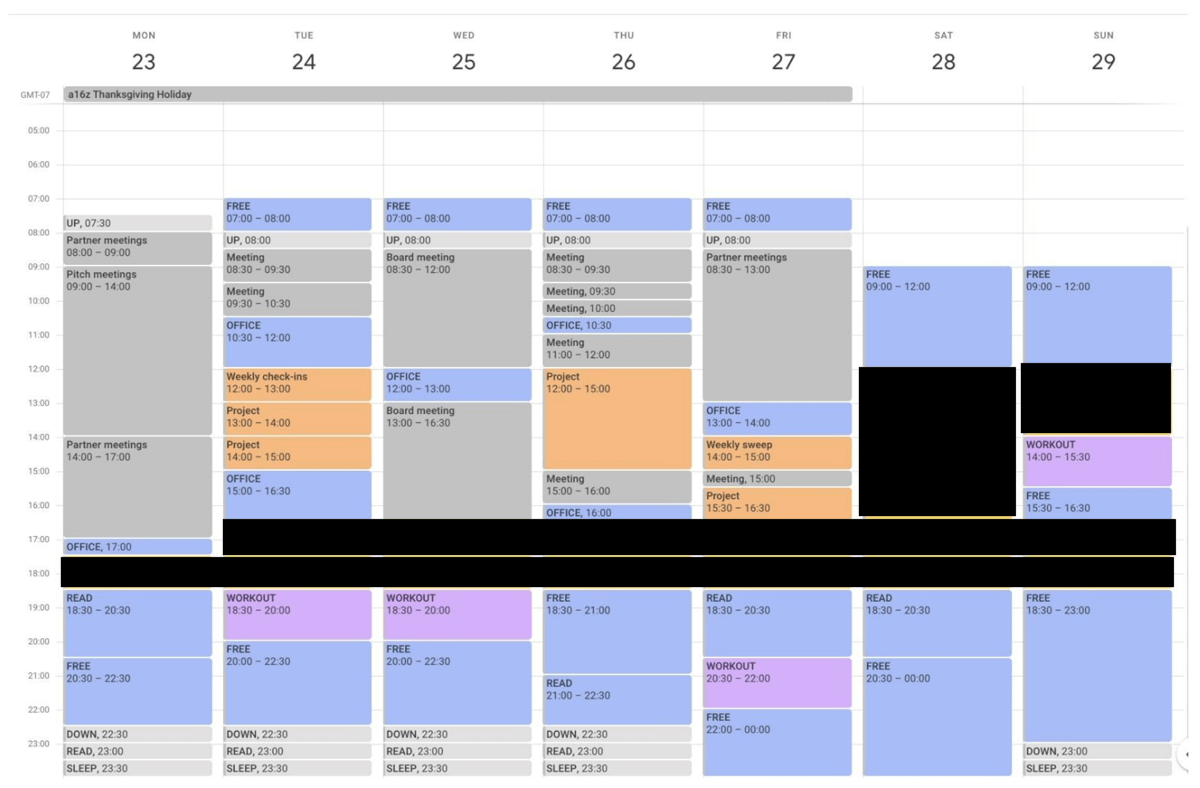
1. Don't keep a schedule* and avoid committing to future meetings so that you can work on the most important and/or most interesting at any time.
This is probably one of the most difficult parts of hiring for many people. Scheduled meetings, daily stand-ups and other mandatory events of flexible development methodologies 😉 When there is a team, it is difficult to refuse, but try to analyze how much you were needed at each of the meetings held last/this week? Often people abuse the opportunity to call a meeting, although many issues can be resolved over text and asynchronously.
*an important note is that Mark keeps a schedule as such, but with the important condition of having focused time for himself and the projects that concern him and with a certain rhythm of the week (quiet and active days).
2. Only three lists: Todo (Must Do) / Watch / Later. Organize tasks into these categories.
I love lists, but I have more. Some physical (planner for your business and home, list of work tasks for the day/week), some online (reading, films, ideas, etc.). So far I find it comfortable to live in such a paradigm. Yes, sometimes there is quite a wide choice of what to do next, but this is balanced by internal settings.
3. Every evening, prepare a 3x5 card: write down 3-5 important tasks for the next day.
Mark simply takes something that is on his Todo list and the next day he tries with all his might (I try like hell) to do what was planned.
I usually have a plan from the beginning of the week, but there are always adjustments and this evening check-up looks like a good addition to my practices. It's worth admitting that the internal feeling when you complete your planned tasks is very pleasant.
4. Keep an Anti-Todo List: Write down your accomplishments throughout the day for motivation.
To be honest, I tried several times to do a similar practice, only not at a moment in time, but retrospectively, but the problem arises that if you did a lot of things in a week, you won't remember everything in your head. I plan to add this practice to my day to better understand what my focus was today.
5. Practice structured procrastination: Use your tendency to put things off to cover other tasks.
Andreessen uses this one of the most "honest" techniques: if you avoid the big scary thing, use this fuel to cover up the useful little things. Yes, you can fall into the trap here and avoid large tasks for a very long time, so the main rule is to first complete the Top 3 tasks from ToDo, and then procrastinate in a structured manner.
6. Apply strategic incompetence: Avoid undesirable tasks by appearing "not very competent" at them.
It sounds funny, but there are questions where it is better to pretend that you cannot take on something and spend time on what is interesting and important to you. It's okay to refuse or refer someone to someone else if it's not your responsibility.
But be careful, if you do this on an ongoing basis and for a large number of requests, they may want to replace you.
7. Check your email only twice a day: fewer distractions, more focus.
Despite the fact that now there is more communication in Telegram and other instant messengers, I still love mail and parsing mail can take quite a lot of time. It is worth recognizing that if there is something very important, they will most likely call or write to you.
I use the Spark email client, and to support Zero Inbox, I snooze emails with newsletters and not-so-urgent information until the weekend, where I do the final analysis of links and texts.
8. Process mail efficiently: clean out your inbox, use action folders, and keep only three main folders (Pending, Review, Vault).
This is not the first time I've seen advice on folders, but I still haven't come around to it, I'll have to try it. In general, this helps to put things in order in the mail, but I have so far been able to support Zero Inbox with my practices, because... mail of a different nature and basic communications in instant messengers.
9. Don't answer calls: let them go to voicemail; call back in batches.
No comments here. Who even answers them? It's just a pity that you can't record an answering machine now.
10. Wear headphones: People will be less likely to distract you.
My favorite point. Often in the office, I can sit with headphones on, without even anything playing, so that I can be in a state of flow and not be distracted.
11. Start your day with breakfast at the table: fuel your body and mentally prepare for the day.
It may sound funny to some, but having morning rituals is an important part of how your day will be structured later. The important point is that breakfast should be without distraction, not on the phone or laptop, so you can tune in for the coming day.
12. Agree to new tasks only when both your head and heart say "yes."
I can already foresee comments in the spirit of "how to refuse my product if my heart says "no"?" But look at this question from the other side and try to use it as a filter for everything you have to do other than the main job (what you were hired for) work.
13. Do what you love: Focus on your core interests and dreams.
A smoothly flowing point from the past.
Sometimes it is important to look at yourself from the outside and understand how much you invest in your current work. Is it right for you and are you getting strong results?
I think this is an important point at any place and at any time.
Instead of an afterword, please share what points work for you? Which ones are annoying? What have you tried from this?